Catalog Your Vinyl Record Collection
Cataloging a vinyl collection by hand means transcribing sleeves, labels and matrix numbers — which is why most crates never get cataloged. With TrophyShelf you photograph the sleeve and AI autofill fills in the artist, the album and the year; you grade it, add what the runout tells you, and move to the next one. A crate of 50 records is an afternoon, not a weekend.
Organize by crate, not alphabet
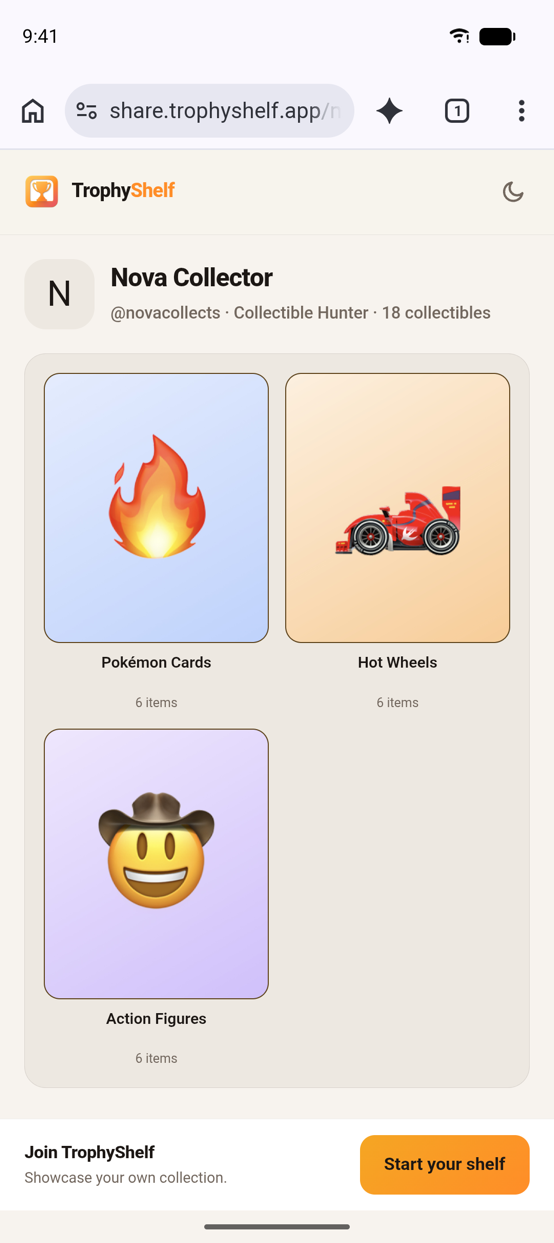
Mirror your physical setup: one collection per crate or genre (“Jazz”, “Original Pressings”, “45s”). The shelf shows each crate as a tile with a live count, and grid view turns a crate into a browsable wall of sleeves.
For collectible pressings the details are the value: the year, the label, the sleeve and vinyl graded apart, the matrix number etched into the runout. TrophyShelf has a field for two of those, and it is worth knowing which before you start — see what it records for a record, below.
What it records for a record
TrophyShelf is a shelf, not a discography. The type you want is Music, and it is deliberately short — five fields, one of which is the format. Knowing that up front saves you hunting for boxes that are not there.
Which type do I pick?
Music — 🎵 in the picker. Vinyl is one of its Format options, alongside CD, cassette, 8-track and digital, which means a crate and the CDs you never got round to selling live on the same shelf and stay tellable apart.
Do not pick Vinyl Figures. That is the Funko-style category and has nothing to do with records.
What are the five fields?
- Artist and Album / single — the two the AI reads straight off a sleeve.
- Format — Vinyl, CD, Cassette, 8-track, Digital.
- Year — a date rather than a plain year, on the reasoning that a pressing has a release day, not just a season.
- Condition — one scale, shared with every other collectible in the app.
Where do the pressing details go?
The description, and the photographs. There is no field for the label, the catalogue number, the pressing plant or the matrix. If you came from Discogs expecting them, that is the gap.
What you get instead is the evidence itself. A legible runout photograph is better proof of a first press than a matrix number typed into a box, because the number can be mistyped and the groove cannot. Shoot it, write what you read in the description, and the record carries its own argument.
Can I grade the sleeve and the vinyl separately?
Not as two fields — there is one condition scale per collectible. Grade the record on it, since that is what the shelf badges and what a buyer asks about first, and put the pair in the description the way it is quoted: VG+ sleeve / NM vinyl.
So is it the wrong app for a serious collection?
It depends what the catalogue is for. If you are pricing a collection against pressing variants, a discography database is the right tool and always will be. If you want the crate photographed, gradeable, searchable and openable by anyone you send a link to — without them installing anything — that is what this does, and the five fields are enough to hang it on.
Photograph what matters on a record
Four shots do the job: sleeve front, sleeve back, the label, and the runout groove. Add a spine shot for box sets. The label and runout are what distinguish an original press from a reissue — and what the AI uses to pin down the pressing.
Catalog your crates in TrophyShelf
- Create a collection per crate or genrePick Music in the type picker — there is no entry called “vinyl”. Vinyl is a format inside Music, alongside CD, cassette, 8-track and digital.
- Shoot sleeve, label and runoutUp to 10 photos per record; the label and runout shots pin down the pressing.
- Confirm what the AI filledArtist, album and year pre-fill from the sleeve. Original versus reissue is yours to establish — from the runout photo and the description.
- Keep values private, share the wallKeep the crate unpublished while you work, then publish it and flip individual records private if you would rather not show them.
- Watch what resonatesView counts and Insights show which records people stop scrolling for.
Pro tips
Questions
How long does a crate take?
A crate of 50 is an afternoon rather than a weekend, because you are photographing sleeves instead of transcribing them.
Can I grade the sleeve and the vinyl separately?
Not as two fields — a collectible carries one condition scale, so grade the record on it. Write the pair the way a buyer asks for them (VG+ sleeve / NM vinyl) in the description, which is free text and sits right under the grading.
Will it tell an original press from a reissue?
The AI pre-fills the title, artist and year from the sleeve and label, and you verify the pressing yourself. Shoot the runout in raking light so the matrix number is legible.
Ready to put it on the shelf?
Free on iOS & Android · Unlimited collections · 15 AI autofills a month · No credit card.
Start your shelf →