Catalog Your Watch Collection
A watch collection app is only as useful as the reference number it records. TrophyShelf gives that its own field, alongside the caliber, the complications, the case and the bracelet — fifteen in all, the deepest type in the app. It also has a serial number field, and the most important thing on this page is when not to fill it in.
The reference number is the watch
Brand and model get you to a family. 116610LN gets you to a watch: the ceramic-bezel Submariner Date, black dial, the 2010–2020 generation. Collectors trade in reference numbers because they are the only part of the description that cannot be argued with.
TrophyShelf gives it a field of its own rather than burying it in the name, which means a shelf of forty watches stays searchable against every forum thread and price guide written about them.
What a watch records
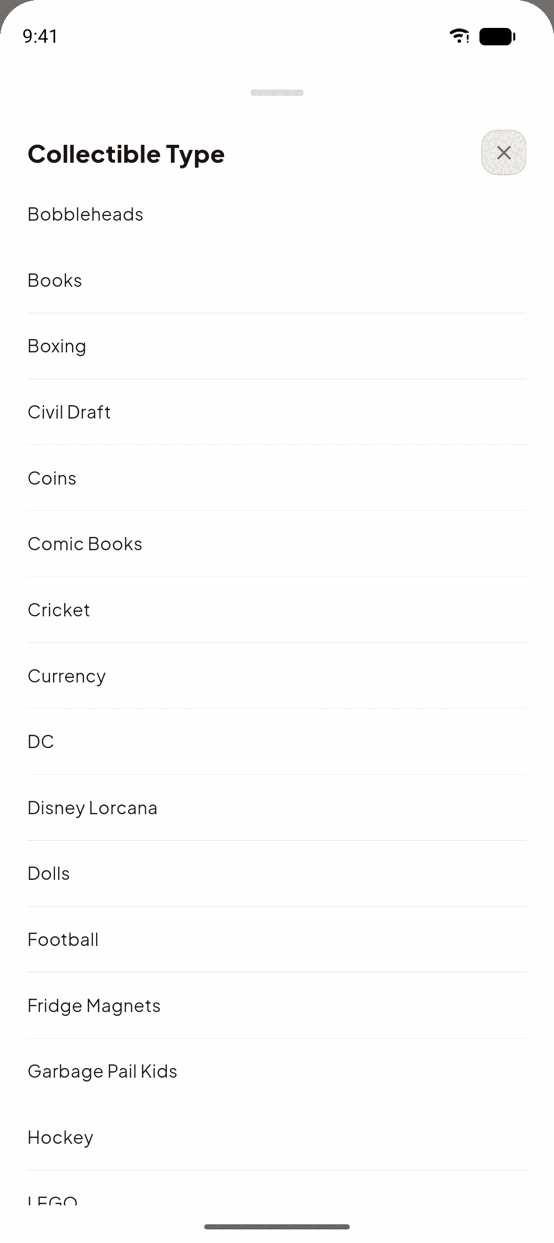
The type is Watches — ⌚ in the picker — and it is the deepest schema in the app: fifteen fields of its own on top of the universal ones.
Which fields identify it?
- Reference number — the one that settles arguments.
- Caliber — the movement inside, Cal. 3135 and the like. Two watches sharing a reference can carry different calibers across a production change, and the caliber is what a watchmaker asks for.
- Serial number — see the warning below before you fill this one in.
- Brand, Model and Year of manufacture alongside them.
What goes in Complications?
It is a multi-select, not a text box, so a watch can carry several honestly: Date, Chronograph, GMT, Moonphase, Perpetual calendar, Tourbillon and Power reserve.
Around it sit the fields that describe the object rather than the movement — Case material (steel through platinum, titanium and ceramic), Case size, Dial colour, Bezel type, Crystal (sapphire, acrylic or mineral), Bracelet or strap, Movement type and Water resistance.
Bracelet / strap is worth filling honestly: it separates Original bracelet from Aftermarket, and that difference is priced.
Where do box and papers go?
The description — there is no field for them, and for a market that prices “full set” as its own tier, that is the real gap in this type.
So write it first, in the form the market uses: Full set — box, papers, tags, dated 2018, or Watch only. Photograph the papers as one of your ten shots. A photographed warranty card is better evidence than a ticked box would have been, which is some consolation for the missing field.
⚠️ Should the serial number be public?
No. This is the one piece of advice on this page that matters more than the rest of it combined.
A public collectible publishes the fields of its type, and there is no way to hide a single field on a page that is otherwise public — visibility is per collectible, not per field. Publish a watch with its serial filled in and you have published the serial.
Serial numbers are used to fake provenance on stolen and counterfeit watches, and a photograph of a real watch beside its real serial is exactly the raw material for that. Two ways to avoid it, and either is fine:
- Keep the watch private. A private collectible is never written to the public side at all — there is no page, so there is nothing to read.
- Leave Serial number empty on anything public, and keep it somewhere private instead. The reference number identifies the model; the serial identifies your watch, and only you and an insurer need it.
📌 The same reasoning applies to the papers photograph. A warranty card carries the serial in print.
Why is there no grading section?
Because watches are not slabbed. Grading in this app belongs to trading-card types, where a PSA or BGS number is the object’s public identity. A watch gets the universal condition scale instead, and the detail that actually moves its price goes in the fields above and the description.
Do it in TrophyShelf
- Create the collection and pick Watches⌚ in the type picker. One collection is usually enough — a watch collection is counted in dozens, not hundreds.
- Decide visibility before you typeIf the watch will be public, leave Serial number empty. If you want the serial recorded, keep the piece private.
- Photograph the dial, case back and claspDial straight on, case back for the reference and serial engraving, clasp for the bracelet code. Papers too, if the watch has them — up to 10 shots.
- Fill the reference number firstThen caliber. Those two identify the watch to anyone who knows watches; everything else describes it.
- Put box and papers in the descriptionThere is no field for them. Write Full set or Watch only in the market's own words, at the top.
Ready to put it on the shelf?
Unlimited collections · 15 AI autofills a month · No credit card.
Start your shelf →