Track Your Comic Book Collection
Amazing Spider-Man #1 is five different comics, and only one of them is worth what people think. TrophyShelf gives Volume its own field beside the issue number, which is most of what a comic catalogue needs. It has no CGC grade and no variant field, and this guide is straight about where both of those go instead.
Volume is the field that stops the arguments
Amazing Spider-Man #1 is not one comic. It is 1963, and 1999, and 2014, and 2018, and 2022 — five first issues, four of which are worth a fraction of the first, and all of which people write the same way in a spreadsheet.
TrophyShelf gives Volume a field of its own beside Issue number, which is the single most useful thing it does for a comic collection. Fill it even when it feels obvious. Especially then.
What an issue records
The type is Comic Books — 💬 in the picker, name box suggesting Amazing Spider-Man #1. It is a short schema: seven fields, plus the universal ones.
Which fields identify the issue?
- Title / series, Issue number and Volume — together, one specific comic.
- Publisher — a list: Marvel, DC, Image, Dark Horse, IDW, Boom!, Valiant, Independent, Other.
- Cover date / year — a date, which for comics is the cover month rather than the release month. They differ by weeks and collectors quote the cover.
Why are there ISBN and Pages fields?
Because this type sits with Books and Magazines rather than with the trading cards, and it inherits their shape. For a trade paperback or a hardcover collection those two are exactly right. For a floppy off the rack they stay empty, and that is fine — an empty field costs nothing.
📌 It is a useful tell about what this schema is good at: collected editions and runs, more than slabbed single issues.
⚠️ Where does a CGC grade go?
The description. There is no grading section on this type, and no 0.5–10.0 scale anywhere in the app for comics.
The condition control offers the universal six — Mint, Near mint, Very good, Good, Fair, Poor. That is a reasonable summary of a raw book and no use at all for a slab, where the whole point is that 9.6 and 9.8 are different prices.
So write it first in the description, in the market’s own words: CGC 9.8, white pages, cert 1234567001. Photograph the label. A photographed slab label is better evidence than a dropdown could have been, and the certificate number is a public lookup anyone can check.
What about variants and key issues?
Also the description — neither has a field. This is the honest gap in the type, and for modern collecting it is a real one: a 1:25 incentive variant and a newsstand copy of the same issue are different objects with different markets, and a first appearance is the entire reason some issues are collected.
Two things make it workable. The photograph is the record, and a variant cover is the most visually obvious difference there is — you will never mistake one on a grid. And the description is free text at the top of the page, so Variant cover (Campbell 1:50) · 1st app. Miles Morales reads perfectly well to a human, even though nothing can sort by it.
Is this the right app for a comic collection?
It depends what the catalogue is for, and the honest answer is not always yes.
If your collection is slabbed keys held as investments, a grading registry tracks the things you care about — census counts, grade distribution, sale comparables — and this does not pretend to.
If it is long boxes you actually read, runs you are completing, and a shelf you would like to show someone, this is squarely the case it was built for: photograph the issue, let the AI read the title and number off the cover, fill the volume, and get a shareable shelf out the other side.
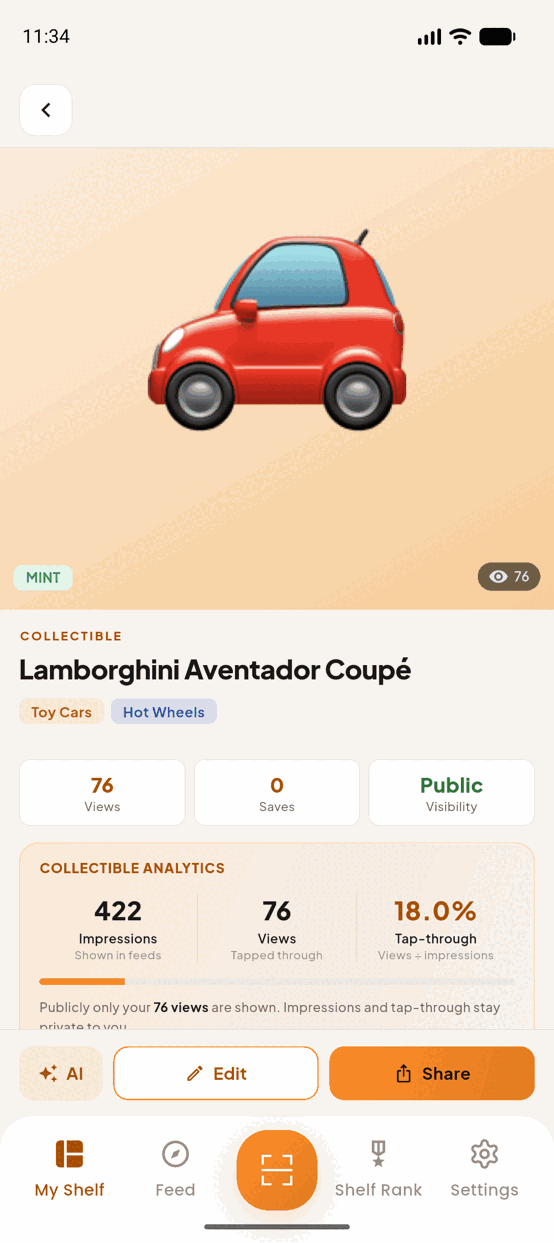
Do it in TrophyShelf
- Create a collection per run or era💬 Comic Books in the type picker. One collection per series or era keeps a long box browsable.
- Photograph the cover, and the label if slabbedCover straight on, back cover, and a close shot of any slab label or signature. Up to 10 photos per issue.
- Fill title, issue and volumeThe AI reads the title and number off the cover. Volume is the one to check yourself — a cover rarely says which it is.
- Put the grade and variant in the descriptionCGC 9.8, white pages or Variant cover, 1st app. at the front. Neither has a field, and both are what a buyer asks first.
- Keep the keys public, the rest as you likeA shared shelf link shows the full run in any browser — no app, no account for whoever you send it to.
Ready to put it on the shelf?
Unlimited collections · 15 AI autofills a month · No credit card.
Start your shelf →